
Simulation shooting ranges are advanced technological training environments that do not use live ammunition at all.
Instead, they rely on laser systems, software, and displays to create interactive virtual scenarios.
These ranges are considered a cornerstone of modern training doctrines, forming the missing link between dry theoretical training and costly and risky live-fire training. At Maknoon, we consider them an indispensable scientific tool for building the correct foundations for the fighter.
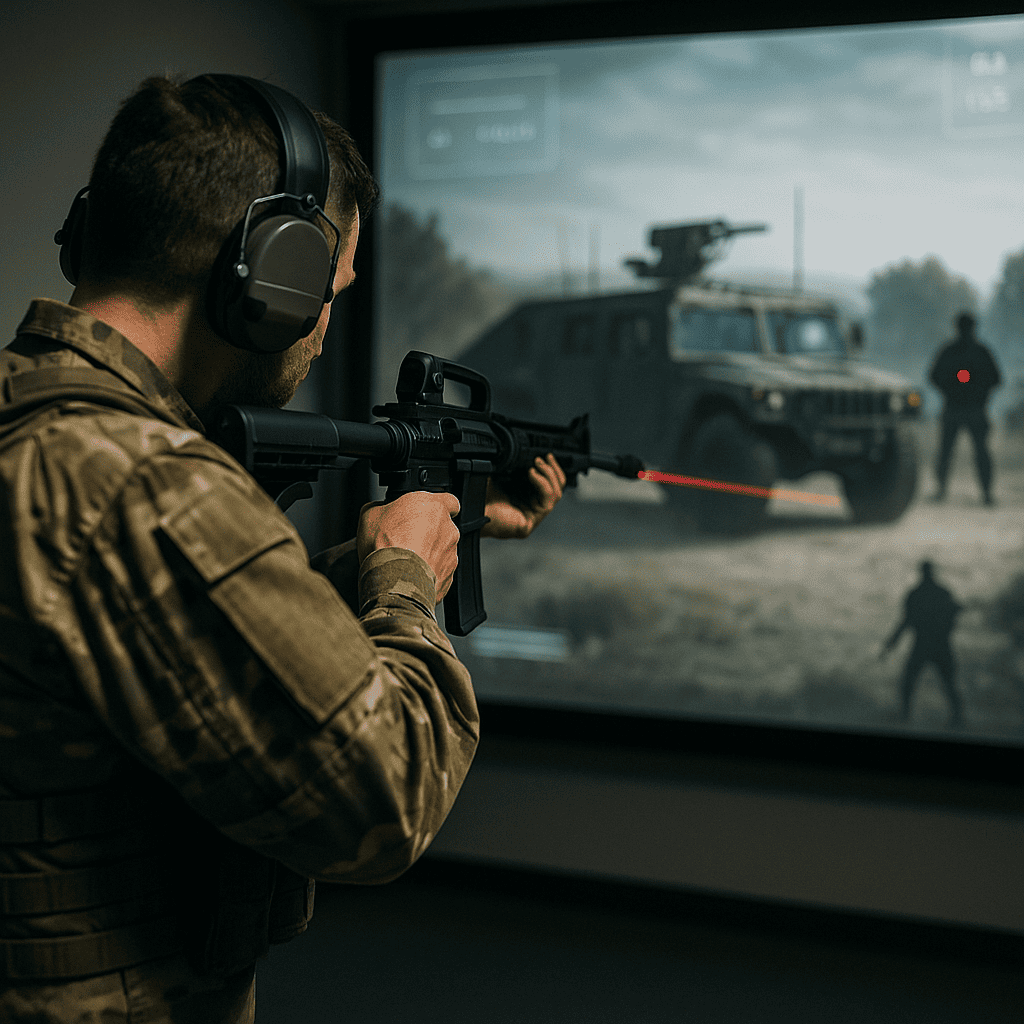
How it Works: How does the simulation system work?
The system relies on the precise integration of hardware and software components to create an immersive and effective training experience:
- Replica Weapons: Weapon models that are 100% identical to real weapons in terms of weight, balance, and mechanism of action (such as section movement and recoil) are used. These weapons are equipped with infrared laser emitters (invisible to the naked eye).
- Detection and Tracking System: Strategically positioned, high-speed, high-resolution cameras detect the laser beam’s impact point on the display screen in a fraction of a second when the trainee pulls the trigger.
- Computer Unit and Software (The Core Engine): This is the system’s “brain.” The computer displays the interactive scenario on the screen, and when the camera detects a laser shot, the software immediately analyzes and records it as a hit or miss, with an immediate reaction within the scenario (such as the target falling).
- Sensory and Analytical Feedback:
- Recoil Simulation: The simulated weapons are equipped with pneumatic or mechanical recoil systems to provide a realistic recoil sensation.
- Immediate Analysis: The system records all shooting data (reaction time, trajectory, accuracy) and displays it in a detailed report for the instructor and trainee immediately after the scenario concludes (After-Action Review).
Strategic Importance in Modern Training Systems
- Absolute Safety: Since no live ammunition is used, it eliminates all training risks, allowing its use in almost any location (even within administrative headquarters) without the need for complex infrastructure.
- Building Correct Muscle Memory: It allows new trainees to learn the fundamentals of marksmanship (grip, stance, aiming, trigger pull) and perform hundreds of repetitions without fear or strain from the sound of the explosion and recoil, thus preventing the formation of bad habits.
- Low Economic Cost: Operating costs are almost nonexistent, enabling the implementation of a massive training volume at a fraction of the cost of live-fire training.
- Decision-Making Training: This is the ultimate value of simulators. They are the only tool that can safely train individuals in situations requiring a decision to engage or not to engage (Shoot/No-Shoot).
Target Forces and Areas of Application
Simulators are suitable for all types of forces but for different training purposes:
- Recruits and military students: For foundational training in basic marksmanship skills safely and efficiently.
- Law enforcement and police forces: For intensive training on force use scenarios and rules of engagement in urban environments.
- VIP protection forces: For training in rapid reaction and close-quarters combat in surprise attack scenarios.
- Special operations and counter-terrorism forces: For training on complex assault scenarios, hostage rescue, and specialized training before real missions (mission rehearsal).
Examples of Scenarios Trainees Face
Scenarios range from simple to highly complex and include:
- Basic Marksmanship Scenarios: Training on stationary and moving targets at varying distances and speeds to hone shooting accuracy.
- Judgment Scenarios:
- Confronting a suspect who suddenly draws a weapon or surrenders.
- The presence of civilians or hostages near the enemy target necessitates precision and perfect timing.
- Dealing with multiple threats that appear simultaneously or sequentially.
- Integrated tactical scenarios:
- Building assault: The trainee advances in a virtual environment and encounters threats emerging from doors and windows.
- Repelling an ambush: The trainee is subjected to sudden gunfire from multiple directions and must respond and take cover.
- Securing a checkpoint: Dealing with a vehicle approaching at high speed and refusing to stop, and making the appropriate decision.
Summary:
The simulated shooting ranges by Maknoon are an indispensable scientific training tool. They move the fighter from the stage of learning “how to shoot” to understanding “when and why to shoot.” In doing so, they develop the most important element of any security or military force: the professional fighter capable of making the right decision in a fraction of a second.