
Given the rapidly evolving nature of modern conflicts and the increasing complexity of theaters of operation, traditional training and field maneuvers, however important, are no longer sufficient to encompass all potential variables and risks.
From this perspective, Maknoon offers wargaming systems as a crucial scientific and strategic tool, representing a virtual laboratory for decision-making and testing combat doctrines—a matter of utmost importance and complexity for powerful armies.
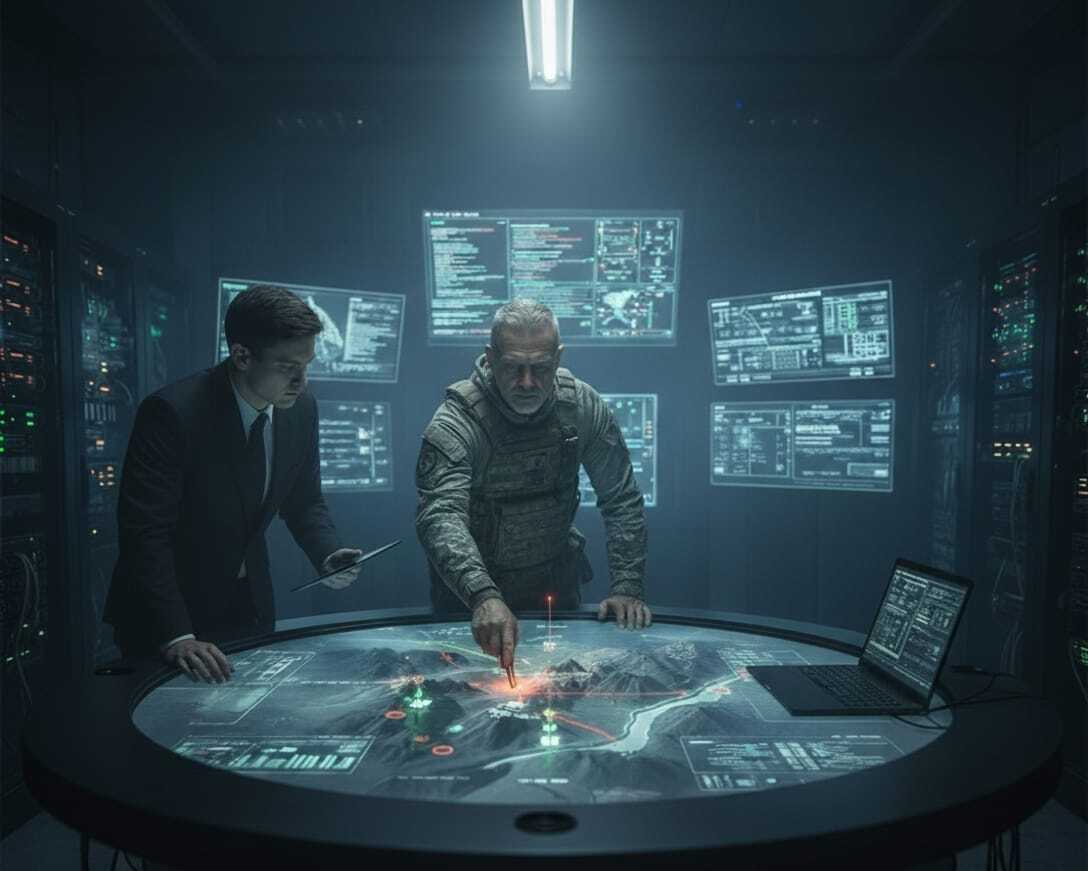
It is not merely a simulation; it is an advanced tactical and strategic simulation environment built on mathematical models and artificial intelligence algorithms, designed to empower commanders to engage in warfare before it begins.
The Scientific and Technical Basis of the System
The “Maknoon” war games systems rely on a simulation engine that models hundreds of dynamic variables affecting the course of battles, including:
- Topography and Weather Conditions: The impact of terrain and weather on unit movement and sensor performance.
- Unit Capabilities: Accurate modeling of each unit’s capabilities (range, speed, firepower, armor) based on real-world data.
- Logistics and Supply Chains: Simulating the impact of fuel, ammunition, and supply consumption on the continuity of combat operations.
- Command, Control, and Communications (C4I): Testing the effectiveness of the command structure, information flow, and the impact of electronic warfare.
- AI Opponent: Using advanced algorithms to create a virtual opponent that makes unpredictable decisions and reacts to the player’s plans, simulating the “fog of war” and uncertainty of real combat.
The Strategic and Operational Importance of Wargaming for Modern Armies
The true value of Wargaming lies in its ability to provide a risk-free environment for achieving vital objectives:
- Testing Combat Doctrines and Validating Plans: It allows commanders and staff officers to test operational plans against multiple and potential scenarios, identifying weaknesses and gaps before implementing them in the field, thus significantly increasing the success rate of missions.
- Developing Commanders’ Skills and Refining Decision-Making: The system places commanders at various levels (tactical, operational, strategic) under the pressures of battle, forcing them to make critical decisions under time constraints and limited information. This is a skill that can only be acquired through experience and intensive practice provided by the virtual environment.
- Resource Optimization: This is the direct benefit I mentioned. By conducting dozens of electronic maneuvers at a low cost, training objectives that previously required.
- Reducing Financial Costs: Significant savings in fuel expenses, equipment maintenance, and live ammunition.
- Time and Effort Saving: Complex maneuvers that previously took weeks of logistical preparation can now be executed in days.
- Preservation of Lives and Equipment: Human and material losses that could result from real-world training accidents are avoided.
- Enhanced Joint Operations: The system provides an ideal platform for training various branches of the armed forces (land, air, sea, and air defense) to operate in coordination and harmony, and to test the interoperability of their different systems.
- International Compatibility: Fully compatible with global connectivity protocols (HLA & DIS), allowing for integration with other simulation systems in joint exercises.
- Support for Standard Military Codes: Ability to use tactical codes for both Eastern and Western blocs (NATO APP-6/GOST).
- Full Arabic Language Support: Arabic-language control, management, and reporting interfaces facilitate use by commanders in the region.
- Post-Mission Review and Analysis (AAR) System: Accurate recording of all events and decisions, with the ability to replay scenarios for performance analysis and tactical development. Strategic Areas of Use:
Command and Staff Training.
- Planning and Management of Air, Naval, and Unmanned Aircraft (UAS) Operations.
- Simulating Border and Crossing Security and Counterterrorism Scenarios.
- Disaster Response Planning, Relief Operations, and Fourth-Generation Warfare.