
As part of our integrated system for establishing and developing shooting ranges, Maknoon offers a specialized section for interactive shooting simulators, representing a qualitative leap in the philosophy of military and security training.
We do not consider them a substitute for live shooting, but rather the scientific and technical bridge that connects theoretical knowledge with practical application in the field, thus creating a more efficient, confident fighter capable of making sound decisions under maximum pressure.
The Scientific and Technical Basis: From Mere Simulation to Engineering Human Performance
Scientifically:
The success of simulators is based on the principles of neuroscience and motor training. Effective training is not limited to hitting the target, but also focuses on building correct neural pathways and developing muscle memory for the fundamental skills of shooting (the basics of shooting). Simulators allow trainees to perform hundreds of repetitions of a skill (such as proper grip, aiming, and trigger pull) in an environment free from the sonic stress and recoil of live-fire shooting. This prevents the development of bad habits like “expecting a blast” or “flinching,” which are the biggest obstacles for novice shooters.
Technically:
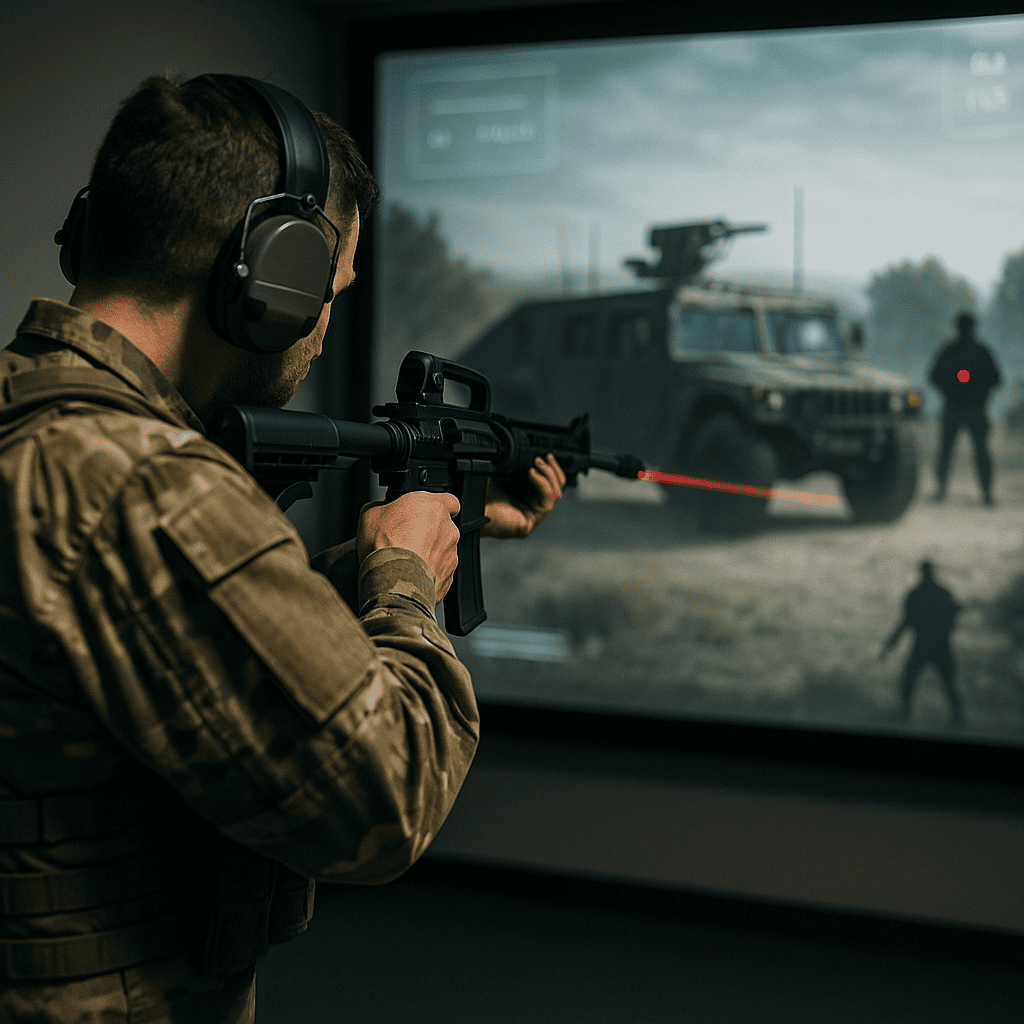
Maknoon simulators are based on an advanced technological architecture that includes: – Realistic simulated weapons: We use weapon models that are identical to real weapons in terms of weight, balance, and feel, and are equipped with high-precision infrared lasers.
High-speed tracking systems:
Advanced cameras capture the laser spot on the screen in fractions of a second and analyze the aiming trajectory before, during, and after the trigger is pulled.
Recoil simulation:
We equip the simulated weapons with pneumatic or haptic feedback systems to simulate recoil, adding a layer of realism to the training. – Performance Analysis Software: The system records and analyzes each shot, providing accurate data to both instructors and trainees, including reaction time, aiming stability, weapon movement during trigger pull, and precise impact location.
Military and Tactical Importance: Beyond Target Hit
The value of simulators extends beyond simply teaching accurate marksmanship to the very core of tactical training:
- Rules of Engagement (ROE) Training: Complex interactive scenarios (shoot/no-shoot scenarios) can be programmed, placing the trainee in realistic situations and forcing them to assess the situation and apply the rules of engagement before firing—training that is difficult to implement safely in live-fire exercises.
- Judgmental Training: By incorporating elements of surprise, moving targets, and friend-or-foe distinctions, the trainee is “inoculated” against stress, trained to maintain situational awareness, and made sound decisions in seconds.
- Training in Diverse Environments: Various operational environments that are difficult to replicate in reality can be simulated, such as combat in populated areas (CQB), in low-light conditions, or from within a moving vehicle.
- Post-Mission Review (AAR) System: The simulator provides the instructor with an unparalleled, objective evaluation tool. The entire scenario can be replayed, the trainee’s performance analyzed step-by-step, and accurate, data-driven feedback provided.
Economic Advantage: A Strategic Investment with a High Return
Adopting simulators is a smart economic decision that saves military and security institutions significant sums in the long run:
- Reducing Ammunition Costs to Zero: The operational cost per round in a simulator is virtually zero compared to the high cost of live ammunition, allowing for intensive and unlimited training on a smaller budget.
- Reducing Logistical Burdens: There is no need to transport ammunition, prepare training areas, maintain targets, or clean weapons after each training exercise, thus reducing the logistical footprint and saving valuable man-hours. – Accelerated learning curve: Trainees can fire hundreds of virtual “shots” in a short training session, a number impossible to achieve in live-fire shooting in the same amount of time, thus speeding up the development of essential skills.
- Absolute safety: The absence of live ammunition means no risk of injury or accidents, making training accessible to a wider range of individuals and in multiple locations that do not require the stringent safety features of live-fire ranges.