

Tank fire is not simply the act of firing a shell; it is a science and a specialized discipline that represents the ultimate test of an armored force’s capabilities. It is an integrated system that tests the complete harmony between the tank crew (commander, gunner, loader, and driver) and the ability of the tank’s advanced Fire Control System (FCS) to achieve a precise first shot in diverse combat conditions. The goal is not just to destroy the target, but to destroy it quickly and decisively to maintain the initiative in the battle.
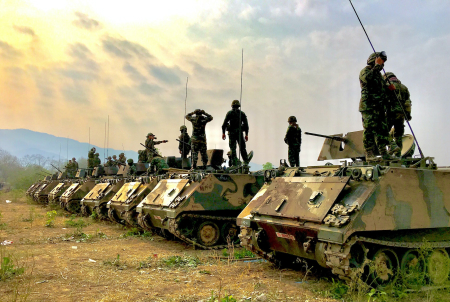
How is tank fire conducted?
Tank fire training is conducted gradually and progressively in increasing complexity and is designed to simulate all possible combat scenarios:
Firing from a stationary position at static targets (Static Gunnery)
Description: This is the foundational stage. The tank is positioned in a designated firing position and engages static targets that appear at varying distances.
Training objective: To master the fundamentals of firing, weapon calibration, and to ensure the entire crew understands engagement procedures and the role of each individual.
Engaging Moving Targets from a Stationary Position
Description: The tank engages moving armored targets moving laterally or diagonally from its stationary position.
Training Objective: To test the ability of the fire control system and the gunner to calculate the required “precedence” to hit a moving target and apply the necessary corrections.
Mobile Gunnery
Description: The tank moves along a predetermined tactical route and engages stationary targets that appear suddenly.
Training Objective: To test the ability of the tank’s gun stabilization system and the crew to achieve accurate hits while moving, which is the core of armored assault tactics.
Complex Scenarios
Description: This is the pinnacle of training. The tank moves and engages multiple targets, both stationary and moving, that appear in rapid succession from different directions.
Training Objective: To test the ability of the entire crew to manage the battle under high pressure and to distribute roles between the commander (prioritizing and searching for new targets) and the gunner (effective engagement). What equipment does Maknoon provide?
Field Design and Infrastructure
- Vast areas with scientifically designed earthworks and rear protection barriers capable of absorbing the immense kinetic energy of tank shells (such as APFSDS).
- Tactical roads and tracks designed for the movement of tanks and armored vehicles.
- A central command and control tower providing a comprehensive view of the field.
Advanced Target Systems
- Pop-up Tank Targets: Powerful mechanisms capable of lifting and concealing full-size (2D or 3D) armored targets.
- Moving Tank Targets: This is the most important component. We manufacture and install robust robotic platforms or rail-mounted systems capable of moving armored targets weighing hundreds of kilograms at varying speeds and tactics across the field.
- Thermal Signature Targets: To provide realistic training using thermal imaging systems at night.
- Command and Control Systems:
- A secure, long-range wireless communications network for controlling all targets from the control turret.
- A centralized program (developed by Maknoon and supporting Arabic) that allows instructors to design, execute, record, and analyze complex scenarios and firing results.
- Command and Control Systems:
What are the available engagement distances?
Modern tanks are designed to fight at long ranges to achieve a tactical advantage. Therefore, the ranges we create are designed to effectively cover these ranges:
- Short to medium range (800–1,500 meters): Typically used for coaxial machine gun (MG) training and basic main gun drills.
- Standard combat range (1,500–3,000 meters): This is the range at which most advanced firing drills take place, testing the full capabilities of the tank’s fire control system.
- Maximum range (3,000 – 4,000+ meters): For specialized fields and tank sniper training, where the maximum effective range of modern armament and aiming systems is tested.