

The “Zigzag Field,” known globally as a “Shoot House,” is not a traditional shooting range. It is a physical simulation and a fully integrated 3D training environment designed to train individuals and small teams in Close Quarters Battle (CQB) tactics.
The essence of its zigzag design lies in creating a series of interconnected rooms and corridors that lack long, straight lines of sight. This forces the attacking force to employ assault tactics, clear corners, and deal with sudden threats at every turn, just as in real life.
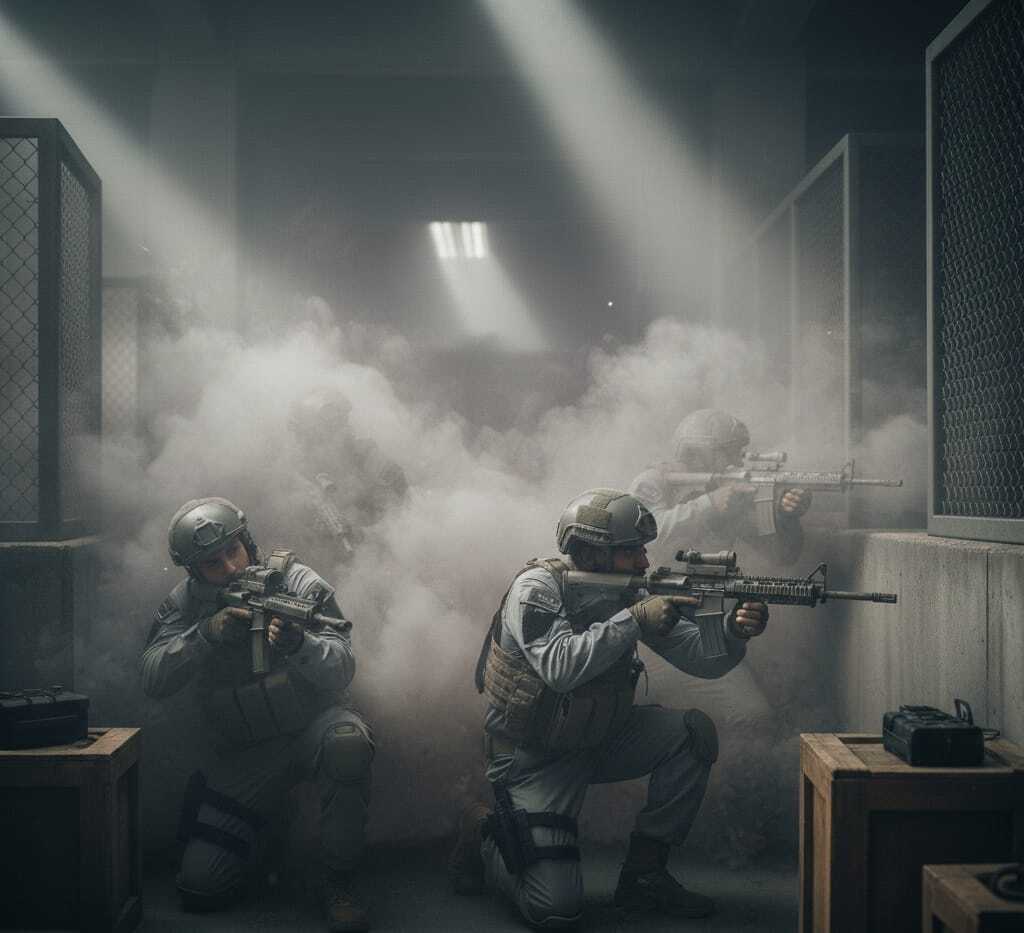
The Engineering Design and Smart Interactive Environment
The training value of these training fields depends on their smart tactical design:
-
Interconnected Rooms and Tactical Doors
The field consists of a network of rooms connected by doors that may be open, closed, or partially closed. This design forces trainees to apply different techniques to deal with each obstacle, whether it’s rapid entry through an open door or applying breaching and clearing procedures for closed doors.
-
Automatic Target Activation System
To achieve maximum realism and surprise, the field is equipped with a network of hidden sensors (such as motion sensors or laser cutters at entrances). As soon as a trainee enters a new room, these sensors activate a pre-programmed scenario, where targets appear suddenly and immediately, simulating the enemy’s reaction to an incursion and preventing the trainee from anticipating the location of threats.
-
Highly Realistic Training Content
To elevate training from mere shooting to tactical decision-making, we equip the training rooms with a carefully considered mix of targets:
- Wooden and paper targets: Representing conventional enemy targets.
- Mannequins in civilian and military clothing: To train trainees to distinguish between friend and foe and innocent civilians, which is the core of Rules of Engagement (ROE) training.
- Moving robotic targets: These are mobile targets on wheels or rails that can be programmed to move between cover or directly attack the trainee, adding an element of dynamism and unpredictability.
Types of Applications: From skill building to final testing
At Maknoon, we offer two versions of these training ranges to cover all phases of training:
Laser Version (Force-on-Force)
Utilizing simulated laser weapons and sensor systems worn by trainees. This version is ideal for foundational training in movement and communication tactics and clearing rooms without any risk. It also allows for team-on-team (force-on-force) drills to enhance competitiveness and realism.
Live-Fire Version
This is the ultimate test of skills. The entire range is constructed of bulletproof materials (walls, ceilings, and floors covered with ballistic rubber) and includes safety bullet traps.
This type of range allows trainees to use their own weapons and live ammunition, adding the full psychological and physical stress of live-fire to the difficulty of the tactical scenario.
Tactical Importance and Beneficiary Forces
These ranges are vital for:
- Mastering essential skills for close-quarters combat (clearing corners, moving through doorways, nonverbal communication).
- Developing reaction speed and the ability to make “shoot/don’t shoot” decisions in fractions of a second.
- Enhancing coordination and teamwork in a highly dangerous and complex environment.
Beneficiary Forces
These ranges are a primary training facility for elite units, most notably:
- Special Operations and Counter-Terrorism Forces. * Special tactical units within police forces (SWAT teams).
- Infantry units specializing in urban warfare.
- VIP protection teams. Urban battlefields and street fighting.