

The Hidden Threat in Shooting Ranges
In any indoor shooting range, the danger isn’t limited to projectiles. There’s another enemy, hidden and silent: contaminated air. With every shot fired, a dangerous mixture of fine particles is released into the air, primarily lead dust from the projectile’s contact with the barrel and the primer, along with gunpowder combustion byproducts like carbon monoxide and other gases. As mentioned, repeated inhalation of this contaminated air leads to serious and chronic illnesses, most notably lead poisoning, which damages the nervous system.
For this reason, the ventilation system at Maknoon Shooting Ranges is not simply air conditioning or exhaust fans. It’s a comprehensive aerodynamic engineering system designed to prioritize the health of shooters and instructors.
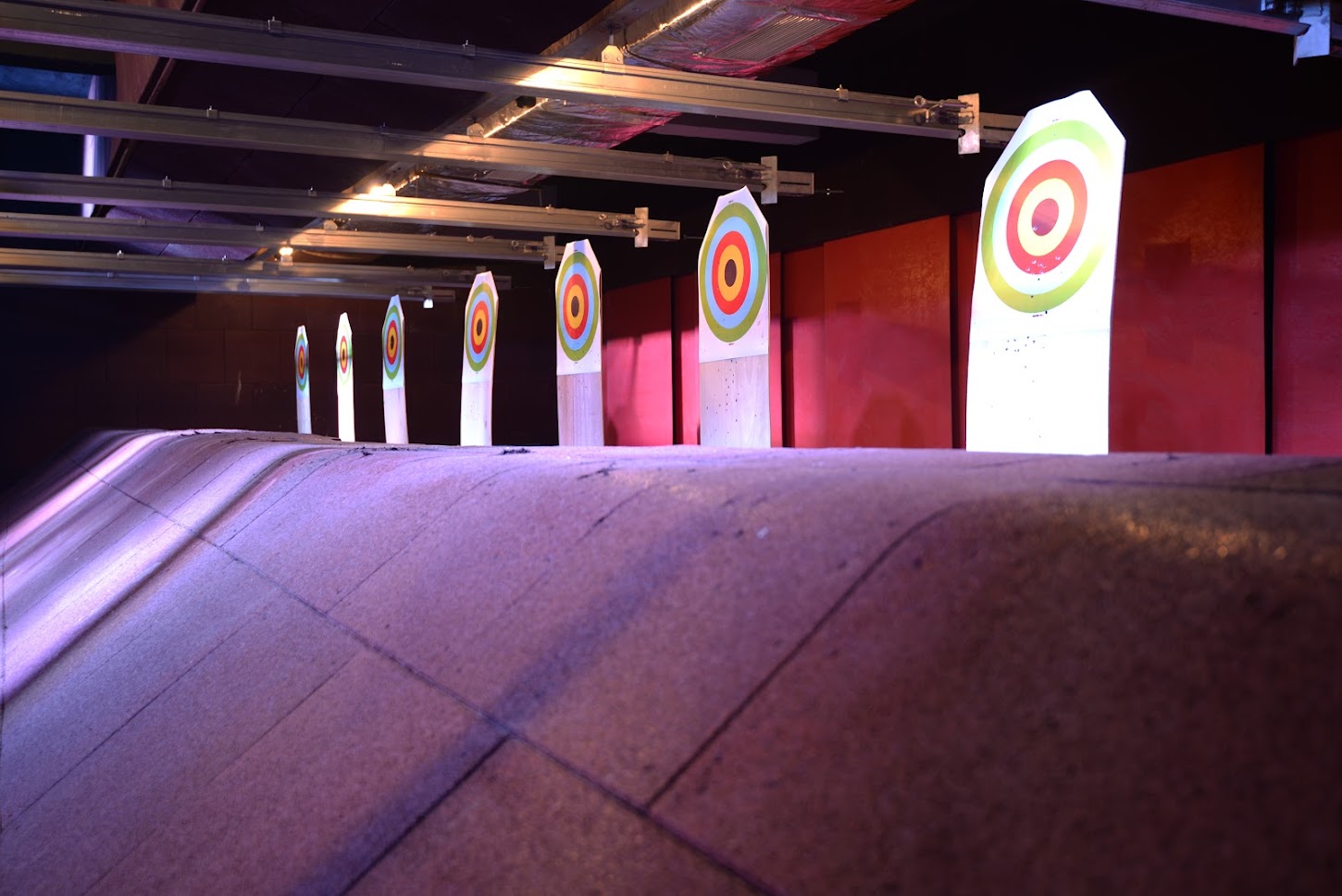
The Vital Importance of an Effective Ventilation System
- Protecting User Health: The primary goal is to ensure that the shooter’s and coach’s breathing zone remains clean and free of contaminants at all times.
- Improving Visibility and Performance: Dense smoke can obstruct vision and affect the shooter’s accuracy and ability to see the target clearly, which an effective ventilation system eliminates.
- Compliance with International Standards: Designing and installing a professional ventilation system is a fundamental requirement for achieving global occupational health and safety standards, which we adhere to in all our projects.
Scientific and Engineering Calculations: How Do We Design a Ventilation System?
The design of a ventilation system is not done randomly, but rather relies on precise scientific calculations that ensure the achievement of two main objectives: Extracting contaminated air and renewing it with clean air.
The First Principle: Laminar Airflow
This is the most important scientific principle. We don’t mix the air within the range. Instead, we design the system to create an “air curtain,” or wall of clean air, that moves smoothly and steadily (without turbulence) behind the shooters, pushing all contaminants ahead of it towards the shot traps at the end of the range, where the intake (exhaust) vents are located. This ensures that any smoke or lead dust is immediately pushed away from the shooter and never returns.
The second principle: Air Change Rate (ACH)
This metric determines how many times the total air volume within the range is replaced with fresh, clean air per hour.
According to international occupational health and safety standards (such as the National Institute for Occupational Safety and Health – NIOSH) guidelines, enclosed shooting ranges require a very high air change rate due to the density of contaminants.
The precise engineering calculations performed by our team, based on the size of the range, the number of shooting lanes, and the type of ammunition used, aim to achieve a rate that ensures the total air volume in the entire range is changed at least 25 to 30 times per hour.
Third Principle: Negative Pressure
We design the range to have a slightly negative atmospheric pressure compared to the surrounding areas. This means that air always flows into the range when the doors are opened, not the other way around, preventing any contaminated air from escaping the shooting area.
Fourth Principle: High-Efficiency Filtration (HEPA Filtration)
The air drawn from the range is laden with bullets and cannot be released directly into the environment. Therefore, it is passed through a series of filters, most importantly HEPA filters, which capture 99.97% of fine particles before the clean air is expelled.
In conclusion:
At Maknoon, we treat ventilation systems with the same seriousness as ballistic protection systems. They are an integral part of range safety.
Through our precise calculations and advanced designs, we ensure that every breath a trainee takes within our ranges is clean and safe, allowing them to fully concentrate on their training while maintaining their long-term health.