


Building Realistic Theaters of Operation for Group Training
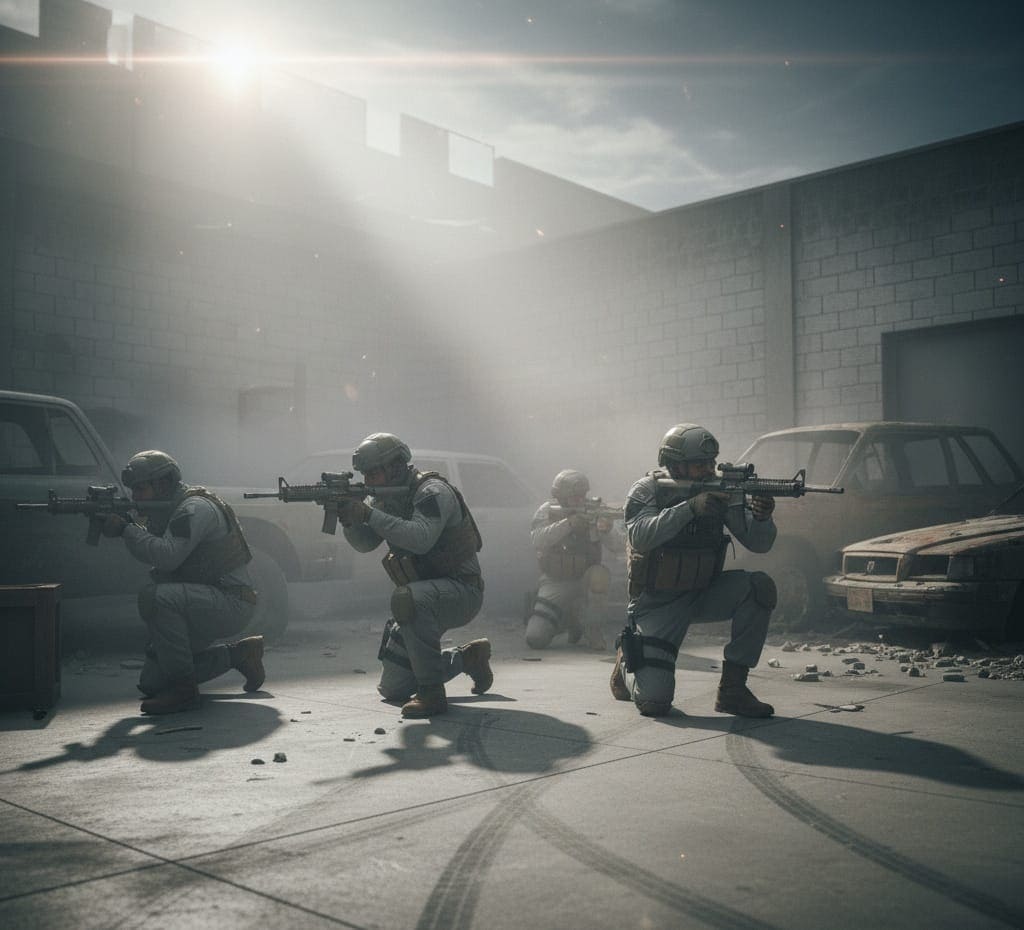
If closed ranges are the “laboratory” where individual skills are honed, then open electronic ranges are the “theater of operations” where these skills are integrated within a collective tactical framework.
Maknoon specializes in designing and engineering these expansive and complex training environments, which aim to train units (from platoon to battalion level) to execute combat missions in conditions that simulate the real battlefield, focusing on the principles of “fire and maneuver” and joint operations.
The Engineering and Technical Principles of Our Field Systems
Creating an effective open range requires overcoming unique technical and environmental challenges, where our solutions excel:
Long-Range Command and Control (C2) Infrastructure
All components of the range, which may be spread over an area of square kilometers, are connected by a robust and secure radio (RF) communications network. This network allows the control tower to instantly monitor hundreds of targets and receive performance data from them, providing a comprehensive view of the training exercises. Our systems fully support Arabic and feature a user-friendly and intuitive interface.
Durability and Environmental Sustainability
All target mechanisms and electronic units are designed to withstand the harshest weather conditions (heat, dust, rain) and have achieved international protection ratings (IP Rating). We also utilize independent power solutions for remote targets, such as solar panels with batteries, to ensure continuous operation without the need for complex electrical infrastructure.
Ballistic Security Design for Large Areas
We apply rigorous scientific standards in field design, including the construction of berms, backstops, and the precise delineation of Surface Danger Zones (SDZs) to ensure that all projectiles, even heavy calibers, are contained within the field boundaries with 100% safety.
Types of Military Open Training Ranges and Their Equipment
We offer a variety of solutions ranging in complexity to meet all training needs:
Type 1: Multi-Purpose Training Range (MPTR)
Description: A basic range designed to train individuals and small units in marksmanship from various distances (starting from 100 meters and reaching 1500 meters or more).
Objectives: Contains fixed infantry targets and pop-up armor, distributed at different distances, to train personnel on using various ranges of light, medium, and sniper weapons.
Calibers: Light weapons (5.56mm, 7.62mm), medium machine guns, and sniper rifles.
Forces: All branches of the armed forces and police for basic and advanced training.
Type 2: Field Firing Range
Description: An advanced range that is not confined to fixed firing lanes but utilizes the natural terrain of the area. This type is designed to train small units (platoons and companies) in combat tactics.
Targets: A mix of stationary and moving infantry targets on linear and curved paths, as well as stationary and moving armored targets, forcing the attacking force to apply tactics of firing, movement, and communication between its personnel.
Calibers: In addition to light weapons, heavy machine guns (such as .50 BMG) and anti-tank weapon simulators are used.
Forces: Infantry units, mechanized infantry, and special operations forces.
Type 3: Vehicle Gunnery Range
Description: A range specialized in training armored vehicle crews (tanks, armored personnel carriers) to engage targets from a moving or stationary position. Targets: Full-scale armored targets (2D or 3D), stationary and moving at varying speeds, sometimes equipped with thermal imaging for night training.
Calibers: Weapons of medium and heavy combat vehicles (such as 25mm, 30mm, and even 120mm cannons for tanks).
Forces: Armored Corps, mechanized infantry units, and border guard forces.
Type 4: Combined Arms Live-Fire Training Area (CA-LFX Area)
Description: The most complex and integrated solution, representing a miniature theater of operations that allows multi-branch units (infantry, armor, engineers) to train in a comprehensive operation.
Targets and Equipment: Contains all the types of targets mentioned above, in addition to intensive battle environment simulation systems (mine and artillery explosion simulators, simulated enemy fire sources) to create a comprehensive and realistic combat environment.
Calibers: Includes all conventional calibers used in land warfare.
Forces: Designed to train company and battalion commanders in command, control, and coordination of operations between different weapons.
Conclusion:
The open training ranges developed by Maknoon represent the pinnacle of field training technology. We provide our clients with the capability to build realistic, safe, and measurable training environments that transform military units from simply groups of trained individuals into cohesive and effective combat forces, capable of achieving victory on real battlefields.